
“Design is not just what it looks like and feels like. Design is how it works.” – Steve Jobs
Rationale: Purpose of Study (taken from the National Curriculum)
Design and technology is an inspiring, rigorous and practical subject. Using creativity and imagination, pupils design and make products that solve real and relevant problems within a variety of contexts, considering their own and others’ needs, wants and values. They acquire a broad range of subject knowledge and draw on disciplines such as mathematics, science, engineering, computing and art. Pupils learn how to take risks, becoming resourceful, innovative, enterprising and capable citizens. Through the evaluation of past and present design and technology, they develop a critical understanding of its impact on daily life and the wider world. High-quality design and technology education makes an essential contribution to the creativity, culture, wealth and well-being of the nation.
Intent
Design and Technology is an inspiring, rigorous and practical subject. It encourages children to learn to think and intervene creatively to solve problems both as individuals and as members of a team. At Nanpean School, we encourage children to use their creativity and imagination, to design and make products that solve real and relevant problems within a variety of contexts, considering their own and others’ needs, wants and values. The children are also given opportunities to reflect upon and evaluate past and present Design Technology, its uses and its effectiveness, and are encouraged to become innovators and risk-takers. We foster links between design in the community which gives children career ideas to aspire to and this also builds a love of learning.
Implementation
At Nanpean School we plan a progressive curriculum, with use of the Kapow scheme to support teaching and learning, that allows children to learn and build on skills mastered in previous years. This enables children to work through carefully planned units of study, master practical skills, design, make, evaluate and improve their final piece.
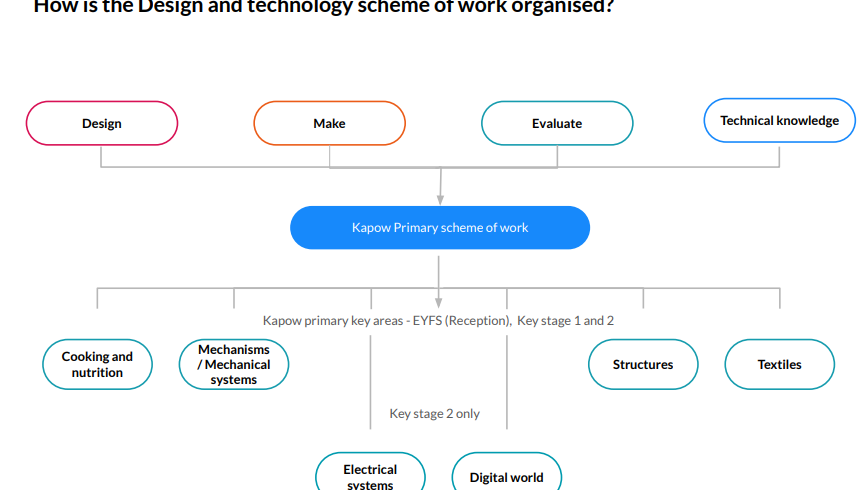
All teaching of DT follows the design, make and evaluate cycle. The design process is rooted in real life, relevant contexts to give meaning to learning. While making, children are given choice and a range of tools to choose from. Children are able to evaluate their own products against a design criteria. Each of these steps are rooted in technical knowledge and vocabulary.
Impact
Our Design and Technology Curriculum is of high quality, well thought out and progressive in terms of children developing knowledge and skills. We ensure our children develop the creative, technical and practical expertise needed to perform everyday tasks confidently and to participate successfully in an increasingly technological world.
British Values
At Nanpean School, British Values are embedded into the Design and Technology Curriculum, where appropriate, while we also learn about British Values at other specific times, such as during Collective Worship opportunities (Assemblies).
During lessons, children complete work with equipment, for example, and this is used to discuss the rule of law to ensure safe use of equipment. Individual Liberty enables children the freedom to express themselves through the design process and in the creation of products. By looking at the achievements of significant designers, engineers or architects, children develop an awareness of how they have influenced and shaped different times (historically) and cultures. This includes an appreciation of their own and others’ work, through supportive and constructive comments when evaluating, and links to the British Values of Tolerance and Mutual Respect. Alongside this, children are encouraged to take the views of others into account and to compromise, when necessary. Again, this teaches them about Mutual Respect and Tolerance. Teaching children to respect and value diversity is encouraged in day to day teaching and learning which helps to prepare children for life in modern Britain, through showing respect for different viewpoints and ideas as well as in the ability to work effectively together.
SMSC

Much of our Design and Technology Curriculum enables links to cultural learning, through our children developing an awareness of how designers, engineers or architects have influenced and shaped cultures and (historical) times.
How you can help your child at home
Why not involve your child in DIY projects at home? Why not plan to fix or make something as a family? Upcycling can be very satisfying as well as cost effective for families.
Also, don’t be afraid to take old products apart, to see and help your child understand how they work.
Why not create recipes, prepare and cook food together? When doing so, consider the importance of a healthy balanced diet, as well as general hygiene when preparing and cooking food. Is there a favourite family recipe that you and your child could create together? This would also link to skills in other Curriculum areas, such as measuring in maths.
The following websites could also be used to support your child:
www.bbcgoodfood.com/recipes/collection/kids-cooking
www.pinterest.co.uk/ldrew77/dt-projects/
www.theschoolrun.com/5-at-home-design-and-technology-projects-for-primary-children